
Size Matters (And No, It’s Not What You’re Thinking of)
Let’s talk about something wildly unsexy but wildly powerful…
Your to-do list.
I know most of you are drowning in them—scrawled on sticky notes, stashed in Notion, or scribbled in margins.
How to make progress on those lists was a hot topic at a recent established leaders meeting I went to. (Mainly for those of us in the group whose genius gifts are not tenacity.)
But luckily, there were those there who get energy from taming their to-do list. They “get sh!t done.”
And their methods were simple:
- Have a system.
- Prioritize.
- Only focus on a few top items at a time.
These folks aren’t just great at working hard; they’re great at working smart. And their approach is backed by cognitive science.
Your Brain Can Only Handle So Much
Your working memory can only juggle about five to nine items at a time. So when your list has 17 competing tasks, your brain becomes a pinball machine, bouncing from one half-finished idea to the next.
That feeling of spinning your wheels isn’t about effort; it’s cognitive overload.
Unfinished Tasks Create Mental Drag.
The Zeigarnik Effect explains why to-do lists can be so mentally exhausting…
When tasks go unfinished, your brain doesn’t let them go. They stay open, like browser tabs you forgot to close—draining your attention and increasing anxiety.
Fewer tasks equal fewer tabs, which means more clarity and focus.
(What does your internet tab status look like currently?👀)
Clarity Beats Hustle, and Knowing Your Genius Helps.
I get it. You’re a business owner. You could work 16 hours a day and still not get everything done.
But the goal isn’t to do everything—it’s to do the right things.
You’ve likely heard of people who move their business forward fast by focusing on just three mission-critical tasks each day. This is often called the “Big 3” or Most Important Tasks (MITs).
In theory, it sounds like a no-brainer, but in practice, it’s hard. Why?
- We gravitate toward the work we are wired to do best, and that may not be what is urgent & important.
- Our “lizard brains” love solving urgent but not necessarily important tasks.
- Important things that require deep thought and perseverance can be hard to start due to overwhelm.
- “Eureka!” moments can strike, making you want to stop everything to capture an idea, derailing the thing you really needed to do.
So how do you quickly shrink a bloated to-do list down to just three important things?
Try this…
Know your genius. The work that frustrates you should go to someone else. The work that lights you up should be a priority.
Find a system that tames your lizard brain.
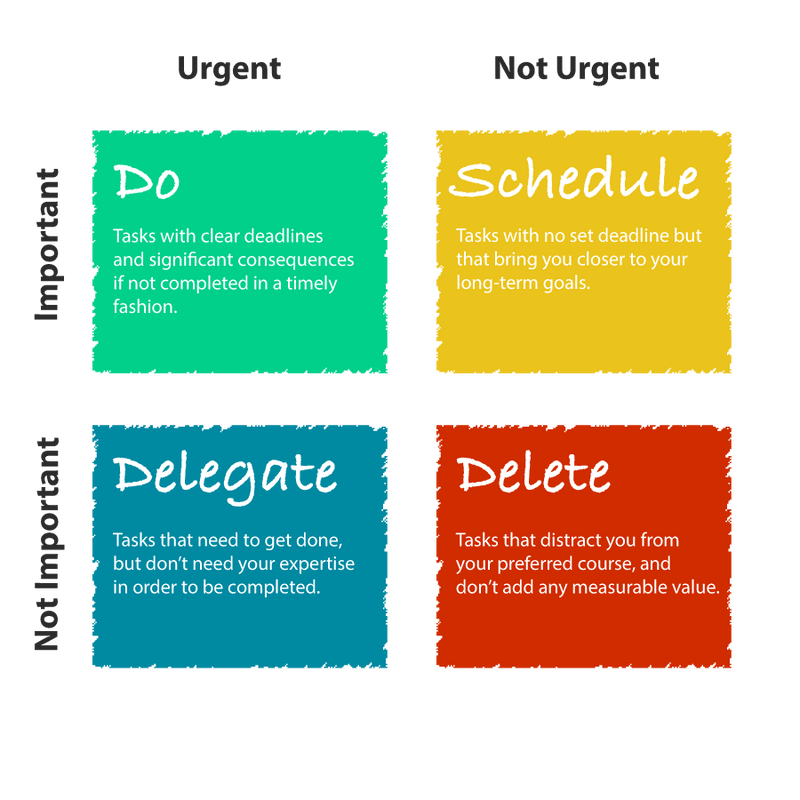
The Eisenhower Matrix is a great place to start and something I use regularly. Every time a new task comes in, plot it as:
- Urgent & Important (your top 3 for the day)
- Important but not Urgent (work to schedule)
- Urgent but not Important (work to delegate)
- Not Urgent, Not Important (practice saying no)
 |
Schedule blocks for deep work and focus only on the items on your small piece of paper.
Have a special place to stash your “Eureka!” thoughts—a journal, a separate note, or a tab on your list, a “brain dump” notebook if you will. Get them out of your head so you can stay focused on your three tasks.
Takeaways:
- When everything’s important, nothing is. The goal isn’t to do everything—it’s to do the right things.
- Start by focusing on just three mission-critical tasks each day and go from there.
If you keep ending every day feeling frustrated, it’s not because you didn’t work hard enough. It’s probably because your list was packed with too many “shoulds” and not enough “musts.”
So here’s your invitation this week: shrink the list, prioritize ruthlessly, and focus on fewer things.
You’ll be shocked at how much more you get done.
Here’s to getting more done by doing less,
Laurie
